

Introduction to Zero-Day Vulnerabilities
Zero-day vulnerabilities are among the most unpredictable and dangerous cybersecurity threats. These security flaws are unknown to software vendors, leaving organizations vulnerable to exploitation before patches become available. Attack Surface Management (ASM) provides a proactive way to minimize exposure to zero-daythreats by ensuring organizations have continuous visibility and control over their digital assets.
Understanding the Zero-Day Challenge
Why Are Zero-Day Vulnerabilities So Dangerous?
- They remain undiscovered until actively exploited.
- No patches exist when they are first identified.
- Cybercriminals leverage them for targeted attacks before detection.
- They frequently lead to major data breaches and financial loss.
As businesses adopt cloud environments, remote work setups, and IoT devices, their attack surfaces expand, creating more potential entry points for cybercriminals.
The Critical Role of Attack Surface Management

Attack Surface Management (ASM) helps organizations identify, classify, prioritize, and monitor IT assets to reduce risk. Here’s how Cytrusst ASM mitigates zero-day threats:
1. Asset Discovery and Visibility
Many organizations don’t have complete visibility into their attack surface. ASM provides an up-to-date inventory of:
- Cloud services, including shadow IT.
- Internet-facing assets and applications.
- Legacy infrastructure that may be vulnerable.
- Third-party integrations and supply chain connections.
With a clear view of all assets, security teams can quickly assess and secure potentially vulnerable systems when zero-days emerge.
2. Continuous Monitoring and Threat Detection
Speed is critical when responding to zero-day threats. ASM solutions enable:
- Real-time monitoring for changes in security posture.
- Alerts on newly discovered or modified assets.
- Detection of unusual activity that may signal exploitation attempts.
- Proactive identification of potential risks before they are publicly disclosed.
By maintaining constant awareness, organizations can react quickly to threats before they escalate.
How Cytrusst ASM Solution Reduces Zero-Day Risks
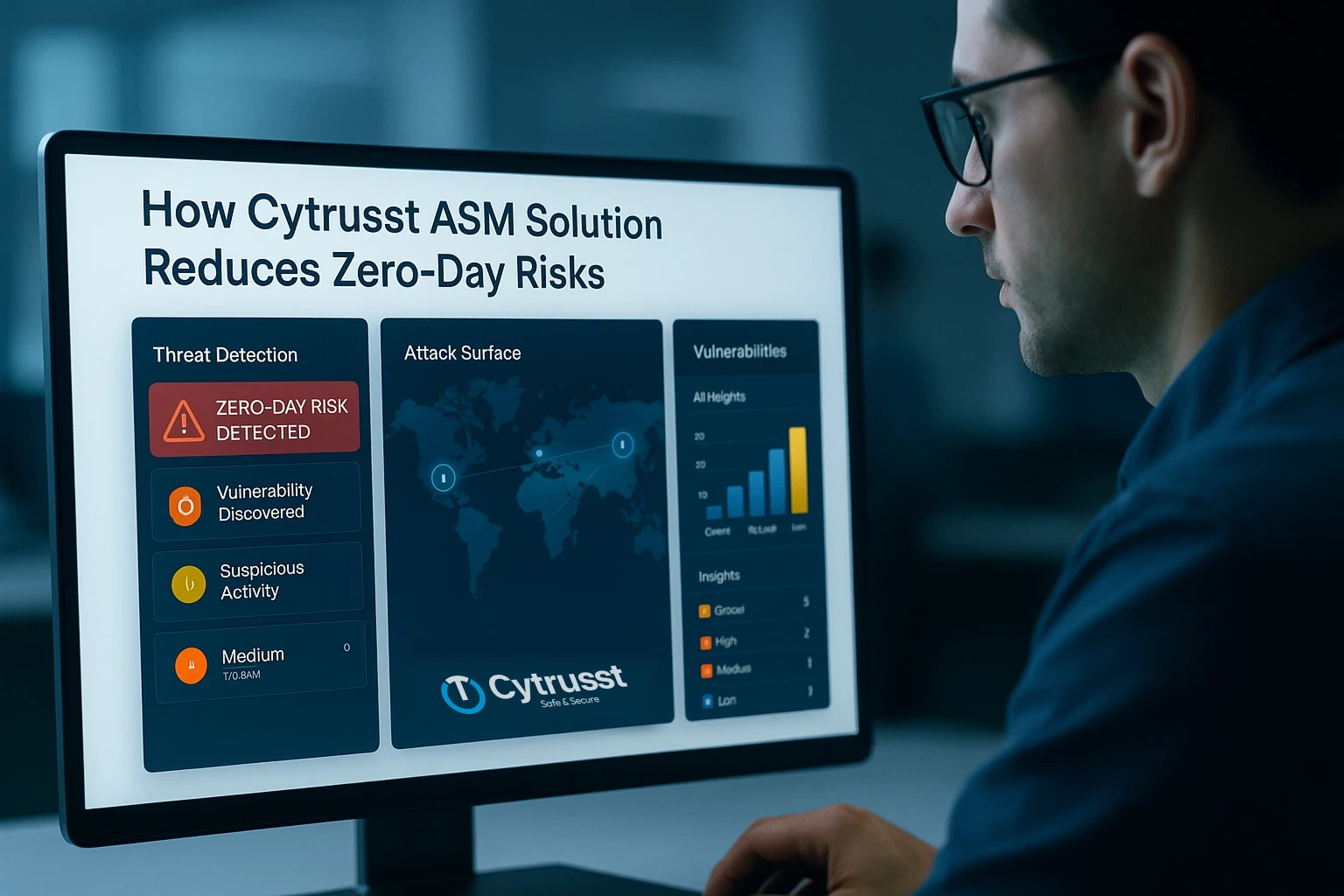
At Cytrusst, we know that early detection and rapid response are key to mitigating zero-day risks. Our ASM solution offers:
AI-Driven Risk Analysis
Instead of waiting for vulnerabilities to be exploited, Cytrusst ASM platform uses AI to analyse attack surfaces and predict potential security weaknesses. This intelligence allows security teams to prioritize and mitigate risks before attackers can take advantage of them.
Automated Asset Discovery
The platform automatically identifies and categorizes all assets within your infrastructure, ensuring no weak points go unnoticed. This is essential when responding to newly disclosed zero-day threats.
Contextual Risk Intelligence
Not all vulnerabilities carry the same risk. Cytrusst evaluates zero-day threats by considering:
- How exposed an asset is to the internet.
- The business impact of a potential breach.
- Possible attack pathways across the network.
- Existing security measures that could mitigate risk.
This level of analysis helps organizations focus their response where it matters most.
Rapid Incident Response Capabilities
When a zero-day vulnerability is disclosed, every second counts. Cytrusst helps organizations:
- Instantly identify affected assets.
- Prioritize mitigation efforts based on risk level.
- Apply temporary protections until patches are available.
- Continuously monitor for exploitation attempts.
This structured approach minimizes the window of opportunity for attackers.
Implementing an Effective ASM Strategy
To maximize the benefits of ASM in reducing zero-day risks, organizations should:
- Maintain a comprehensive asset inventory.
- Implement continuous attack surface monitoring.
- Establish rapid response protocols for emerging threats.
- Prioritize remediation efforts based on business impact.
- Regularly test and validate security defences.
Benefits of ASM for Zero-Day Risk Reduction
Organizations that implement a Cytrusst ASM strategy, benefit from:
- Reduced Exposure Time Quickly identify and secure vulnerable assets when a zero-day emerges.
- Optimized Security Resources Focus efforts on the most critical threats.
- Enhanced Threat Intelligence Gain deeper insights into potential attack vectors.
- Stronger Security Posture Address vulnerabilities proactively, before attacker's strike.
- Better Compliance Management Maintain regulatory compliance even as new threats arise.
Common Challenges in Zero-Day Vulnerability Management
Many organizations struggle with:
- Lack of Visibility- Incomplete asset inventories create blind spots.
- Limited Resources -Security teams are overwhelmed with alerts.
- Skill Gaps -Analysing complex vulnerabilities requires expertise.
- Tool Integration Issues-Security tools often operate in silos.
- Response Coordination – Effective zero-day response requires well-coordinated teams.
Cytrusst ASM solution helps overcome these challenges by providing a centralized view, prioritized threat insights, and seamless integration with existing security tools.
Future of ASM in Cybersecurity
As cyber threats evolve, ASM will continue to advance in several keyways:
- Predictive Analytics-AI-driven risk modelling will improve zero-day detection.
- Automated Remediation – Faster response times with AI-powered mitigation.
- Extended Coverage– ASM will expand to include IoT, OT, and emerging tech.
- Integrated Security Ecosystems– ASM will become a core component of broader cybersecurity frameworks.
- Adversarial Thinking– ASM solutions will increasingly adopt hacker-like methodologies to uncover risks before cybercriminals do.
Conclusion
Zero-day vulnerabilities are an inevitable part of cybersecurity, but organizations can significantly reduce their risk by leveraging Attack Surface Management.
At Cytrusst, we provide businesses with the tools needed to gain full visibility, continuously monitor their attack surface, and respond rapidly to emerging threats. By staying ahead of attackers, organizations can maintain a strong security posture and protect their most valuable assets.
By embedding security into vendor agreements, organizations can set clear expectations and mitigate legal and financial risks.
Ready to Strengthen Your Cybersecurity?
Discover how Cytrusst ASM solution can help protect your organization from zero-day vulnerabilities.
Frequently Asked Questions (FAQs)
1. How is ASM different from traditional vulnerability management?
2. Can ASM completely prevent zero-day attacks?
3. How quickly can Cytrusst ASM platform identify affected assets?
4. Is ASM useful for small businesses or only large enterprises?
5. How does Cytrusst ASM integrate with other security tools? ?